Witnessing new growth in Guangdong–Hong Kong–Macao–Taiwan magic: a review of the 2016 exchange showcase
Witnessing the New Development of Magic in Guangdong, Hong Kong, Macao and Taiwan — A Review of the 2016 Guangdong–Hong Kong–Macao–Taiwan Magic Exchange Showcase
Ning Genfu, Huang Jienong
The 2016 Guangdong–Hong Kong–Macao–Taiwan Magic Exchange Showcase (a 2015 funded project of the China National Arts Fund), hosted by the Department of Arts of the Ministry of Culture, the Guangdong Provincial Department of Culture and the Guangdong Federation of Literary and Art Circles and organised by the Guangdong Acrobats Association and Guangzhou Acrobatic Arts Theatre Co., Ltd., was presented with great ceremony in Guangzhou from 18 to 22 June. More than 240 colleagues from the acrobatics world of Guangdong, Hong Kong, Macao and Taiwan and from Beijing, Shanghai, Liaoning, Gansu, Hebei, Jiangsu, Anhui, Hubei, Zhejiang and elsewhere presented 33 magic acts and four acrobatic acts. Besides the run of performances, the event also included expert reviews, an expert symposium, magic lectures and a prop exhibition and sale, allowing a wide audience to witness the new development of magic in Guangdong, Hong Kong, Macao and Taiwan.
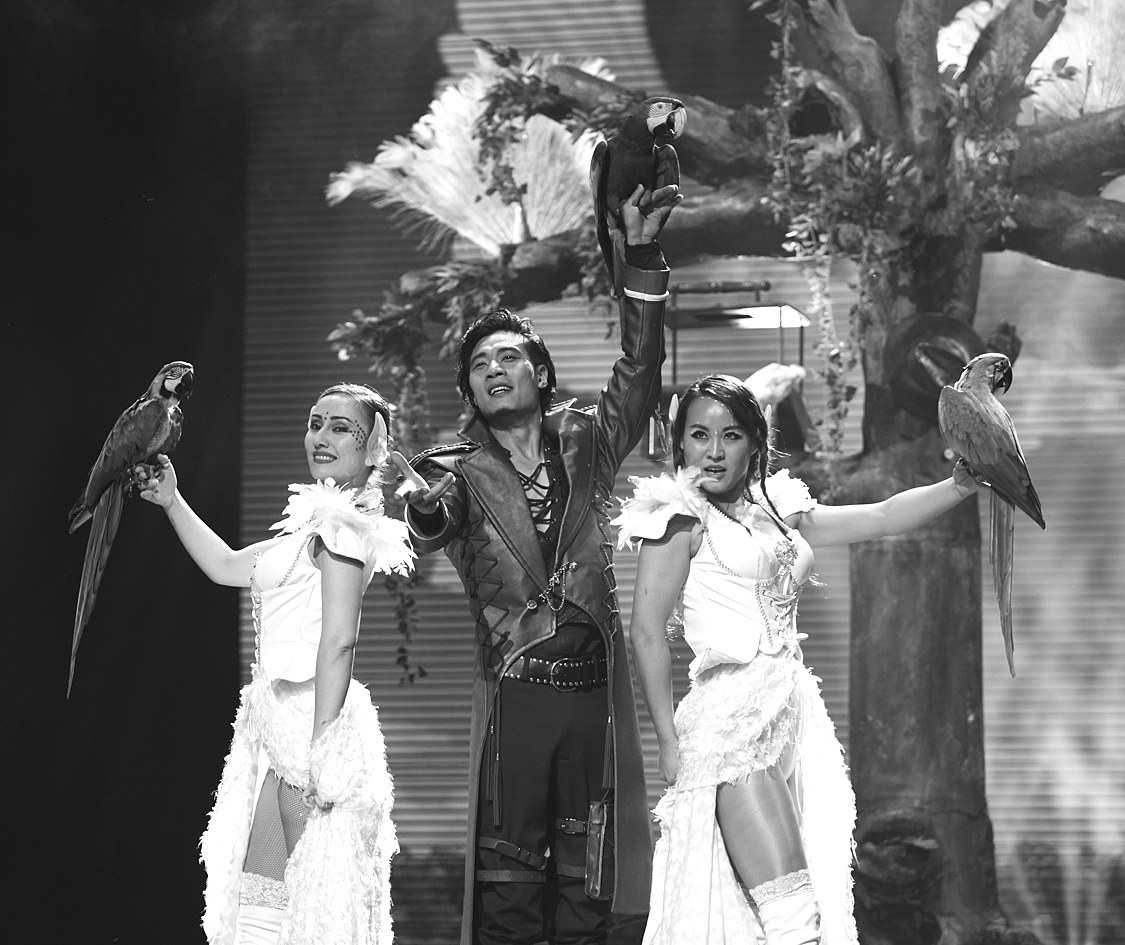
In order to take part in this showcase, some troupes and individuals prepared their acts over a long period and crafted their works with great care; a few were still polishing their pieces as late as the second half of May. Forest Fantasy, the magic work by Hu Linglong and An Na of OCT East, Shenzhen, was grand in scale and strikingly original, its plot full of humane feeling. Moved by a wounded dove goddess, a hunter lays down his rifle. To tender music the magicians produce nine white doves one after another, then two large blue-grey parrots, one large red parrot and two peacocks. Through the hunter's change from killing birds to protecting them, the act conveys the idea that animals are humanity's friends, and the ideal of caring for animals and building an ecological civilisation. Its exploration of subject matter, its innovation and breakthroughs in magic props and its dramatic stage effect left a strong impression on the audience. Dove Dance of Youth, performed by Chen Jinghong of Taiwan, was original in its magic technique. Others continued along the path of carrying forward traditional conjuring: the Gucai Xifa performed by Xu Yang of Beijing was vivid on stage and full of antique flavour. Some took very fresh forms: The Monkey King, performed by Lü Zexian of Jiangsu, combined the magic technique of "face-changing" with elements of Peking Opera facial make-up, using the skills of the sheng, mo, jing, dan and chou role types to portray the Monkey King's seventy-two transformations, to excellent stage effect. Dreamlike Raiment, performed by Zhu Xingtong and Zhu Xiaoqi of Gansu, used costume changes across many dynasties to display the elegance and beauty of dress culture in full, evoking the long-vanished style of the Han and Tang along the Silk Road. Aihemai and Zuli, the married couple from Happy Valley Shenzhen, continued to break new ground in large-scale acts: Phantom Traces, an innovative piece crafted specially for this exchange showcase, used bold imagination and large-scale production to make an object as big as a piano levitate and turn over on stage.
To bring on newcomers in magic and encourage new work, this edition of the exchange showcase added, for the first time, a dedicated programme for rising magic talent, offering an occasion and an opportunity for close exchange among a new generation of magic performers, so that they might learn from one another, make up each other's shortcomings and improve rapidly. The youngest performer in the showcase, Jia Wanying, is only 17 this year; in Happy Girl, her traditional card-changing act, one felt through her sunny freshness the power of youth and the wonder of magic. Artistic Conception, performed by Fan Longxiang of Shijiazhuang, Hebei, packed a great wealth of magic technique and transformation into a short act — flowers produced from empty hands, cards produced from empty hands, flowers turning into silk scarves and into playing cards. Dream of Dancing Discs, performed by the Liaoning newcomer Li Junfeng, showed us the courage and bold ambition of the new generation: in the shifting of the discs he embodied a style willing to take on the hard things and meet a challenge. Beauty You Can See, performed by He Junxian, a hearing-impaired magician from the Macao Special Administrative Region: we can hear beauty — high mountains and flowing water, the song of orioles and birds. A hearing-impaired person, living in a world without sound, nonetheless chose the magic branch of acrobatics in order to challenge his own limits. That in itself is an unimaginable challenge, and it became one of the suspenses of this exchange showcase, in which the audience witnessed something moving and stirring.
Close-up magic has the advantage of simple props and easy performance, and is especially popular among university students and white-collar workers. In recent years close-up magic has developed and spread considerably. At the close-up magic programme we saw Card Artistry · chick by Jian Lunting of Taiwan: in just a few minutes this close-up act carried out changes in the value of the cards, in their number and in their colour, leaving people puzzled and mystified. In Coin Fantasy, performed by Zhang Wei of Liaoning province, a few silver coins appeared and vanished, came and went beneath the magician's hands, embodying the charm of close-up magic to great effect. Card Fantasy, performed by Chen Zhichao of Hefei, Anhui, brought the audience surprise and reflection through changes of every kind. Especially gratifying was that Traditional Conjuring and Gucai Xifa, both rich in traditional character, were shown at this exchange showcase — which is to say that the traditional magic praised for its timeless charm is being valued and carried on by a new generation of magic performers.
Three outstanding acts that have won multiple international gold awards — including the "Golden Clown", the highest honour in international circus — took part in the congratulatory performances of the 2016 Guangdong–Hong Kong–Macao–Taiwan Magic Exchange Showcase: Bowl Balancing by Thirteen from the China National Acrobatic Troupe, Zen and Martial Arts — Head-Balancing Skills from Zhejiang Quyi and Acrobatics Troupe Co., Ltd., and Soul of the Terracotta Warriors — Unicycle Skills from the Wuhan Acrobatic Troupe.
Performers of the Taiwan Acrobatic Troupe presented Grand Martial Arts — Harvest, an act built on the elements of traditional Chinese martial arts that recreated the customs and local flavour of Taiwan's indigenous peoples; the staging was expansive, the mood joyful, and the audience response was warm. During the registration and programme-selection stage of this exchange showcase, so many entries came from Taiwan that the organising committee sent three people to Taiwan specially to assess and select the performers and acts, including the hosts, one by one. Even though limits were placed on the number of acts and participants, in the end as many as 50 people took part — four times the number at the previous magic festival. The great majority of them were coming to the mainland for the first time, and through the exchange showcase they came to know their mainland colleagues better.
Working classic acrobatic acts into the programme of the main performances in Guangzhou was a notable feature of this event. The addition of classic acrobatic acts remedied the shortcoming of an all-magic gala being rather too solemn and heavy and not lively enough; it both enriched the content of the evening and added to the stage effect. This way of organising the performances better met the audience's expectations and won recognition and praise from colleagues everywhere.
After the rising-talent programme and the close-up programme, the performers were immediately brought face to face with the reviewing experts. The experts commented there and then on the performances of the newcomers and the close-up performers, affirming their achievements and progress, pointing out shortcomings and offering suggestions for improvement. This method of review was the first of its kind at such an event, and it worked very well. Many of the experts passed on a lifetime of experience, insight and reflection to these performers in earnest terms. The performers' response was very strong; they said this was advice they could not have obtained anywhere else. After the reviews, many of them shut their doors to discuss, digest and absorb what they had heard, feeling that listening to such a review had brought them more than winning a prize. This practice of face-to-face review changed the old pattern in which performers came to an event thinking only of winning a prize and hurried away once they had it, gaining little of real professional value. It helps the event to focus genuinely on exchange, helps to advance and raise the level of the art, and helps such exchange showcases to pay more attention to serving society and benefiting the public.
From 23 to 28 June the acts from Guangdong, Hong Kong, Macao and Taiwan went in turn to the auditorium of South China University of Technology in Guangzhou University Town, to Nanshan District in Shenzhen, to the Ma Sicong Art Centre in Shanwei, to Jieyang, to Haojiang District in Shantou and to the central stage of the Culture Square in Longchuan County, giving six public-benefit performances in a row. The audiences' enthusiasm for these public-benefit performances of the Guangdong–Hong Kong–Macao–Taiwan Magic Exchange Showcase far exceeded our imagination. At the performance on the university campus the students greeted every act with astonishingly warm applause and cheers. In turn, the audience's hunger for art encouraged every one of our performers and crew. The weather was hot; some in the audience watched stripped to the waist, while on stage the performers streamed with sweat, and in acts with heavy costumes their clothes were soaked through. Audiences who saw the performances praised the public-benefit policy with one voice. They said again and again that such performances fully embodied "a festival of art, a holiday of the people". And once again we felt deeply that the people are the living source of artistic creation.